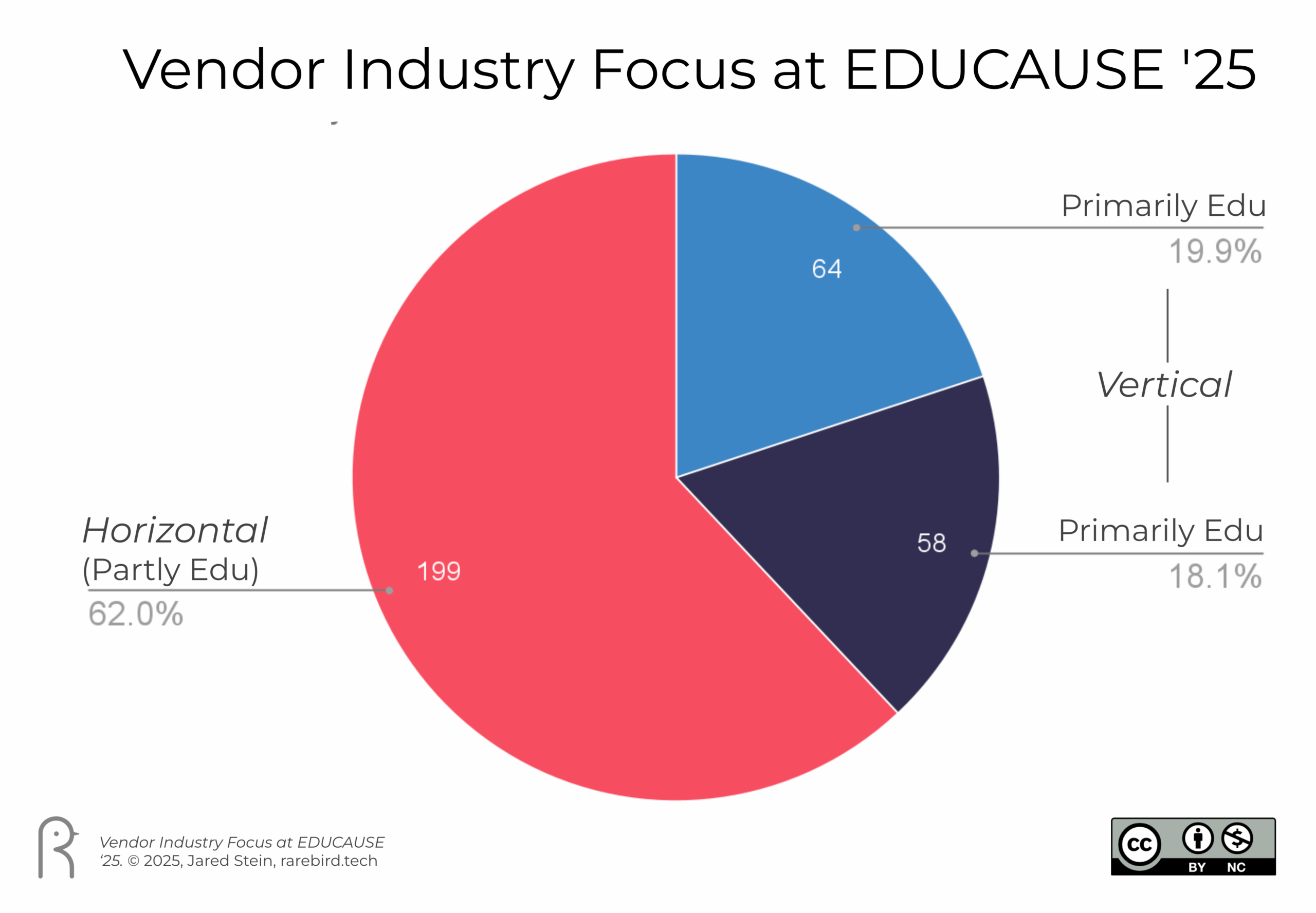
TL;DR: At Educause 2025, general IT hardware, software, and professional / managed services categories are dominated by horizontal companies, whereas (surprise!) more education-specific categories are largely the domain of ed tech vertical companies.

Anyone who attends the annual EDUCAUSE conference knows that the exhibit hall is a mix of education vertical and horizontal companies covering a range of products and solutions. But what’s the mix?
Inspired by ListEdTech’s view of EDUCAUSE exhibitors by category over time, I pulled together a view of exhibitors by industry focus, honing in on those vertical companies (i.e. exclusively or primarily serve education) versus those that are horizontal (i.e. education is just one of several industries served).
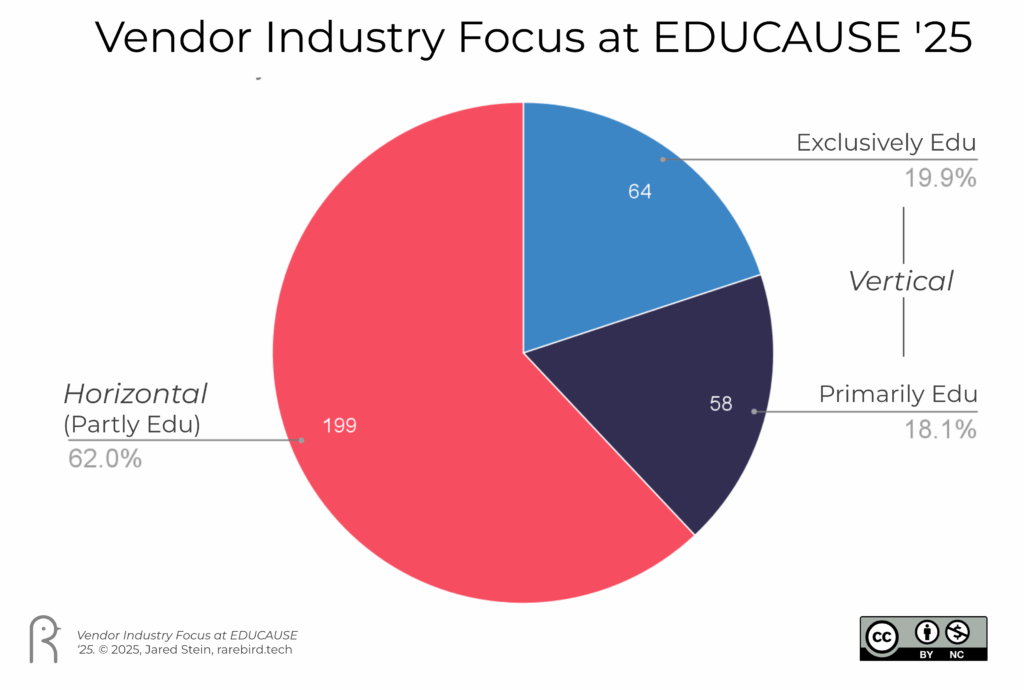
Our categorization shows that nearly 2/3rds of vendors at EDUCAUSE 2025 can be considered horizontal companies because education is just one of multiple industries that they serve. (This is excluding those companies that do serve other industries, but education is still their primary market.)
Here’s another view that looks at companies by their product or solution category (e.g. Learning Management System, Campus Portal, Cybersecurity, etc):
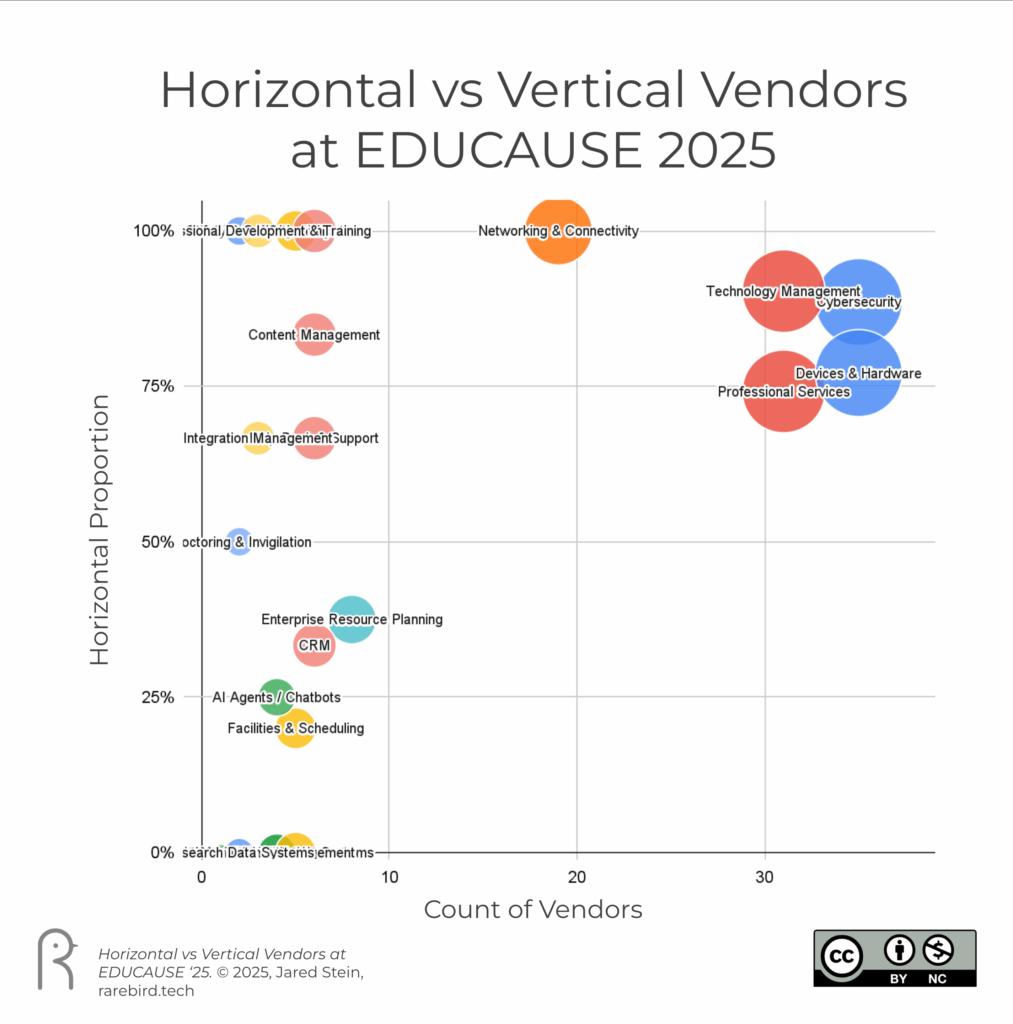
The categories are limited to those with >=4 vendors present. The Y-axis = percent of horizontal companies (not exclusively or primarily serving education) within the category. The X-axis count of vendors within the category (also shown by size).
And here are the top 10 horizontal categories, sorted by percent of horizontal vendors within the category, then number of vendors within the category.
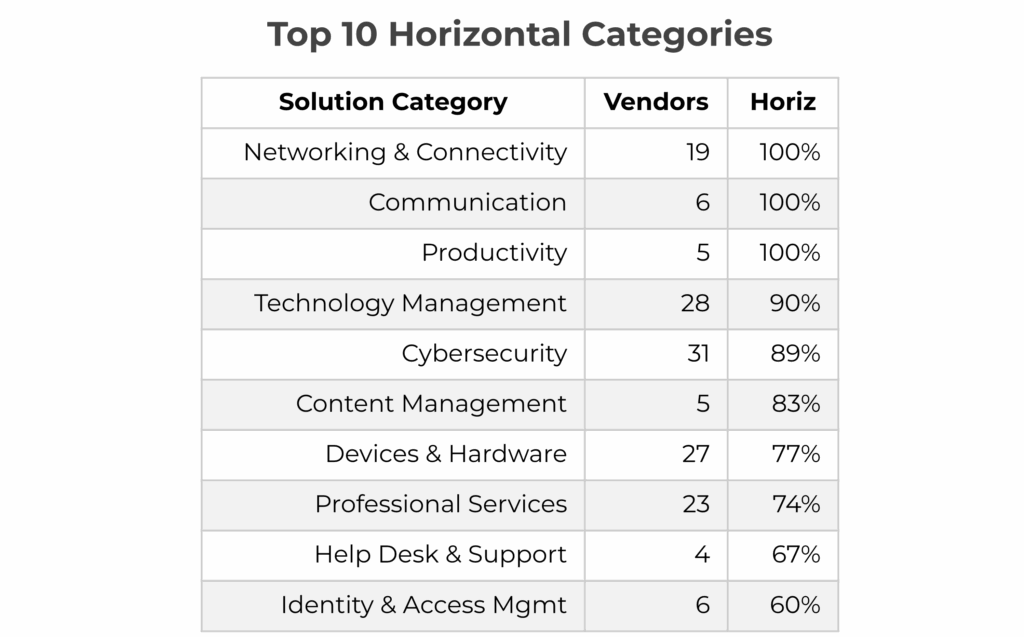
We see that day-to-day computing and internet hardware, software, networking, and services are largely dominated by horizontal players – which makes sense, as these solutions are generally not specific to education, nor are education’s needs dramatically different from other non- or for-profit organizations.
Why does this matter to ed techs or investors?
Identifying companies (and categories) as primarily vertical or horizontal helps ed tech companies and investors understand and focus on market opportunities.
For example, knowing whether a company is marketing primarily to the education vertical or to multiple industries can be important for ed tech companies or investors that are looking to acquire. Often, an ed tech that wants to acquire will look for companies that are exclusively or primarily serving education. This simplifies how a company goes to market and can provide efficiencies from serving a single industry.
There may be instances when an ed tech may want to expand beyond the education vertical by acquiring a company that has proven successful in other industries, but those are rarer.
Knowing whether a category is dominated by horizontal or vertical companies can help an ed tech, investor, or even an entrepreneur evaluate the category as a whole and specific opportunities within the category.
For instance, I’ve been working with a client who has been digging into ed tech product categories that we’ve deemed adjacent and strategic for product expansion – whether through acquisition or new product initiatives.
Several otherwise interesting ed tech categories are largely unactionable for this client because they are dominated by very large horizontal companies. On the one hand, this means that the companies that might be acquired are spread across industries, and thus not a great fit for their very education-focused business. On the other hand, the large, very dominant horizontal companies within that category likely have a competitive advantage that makes entering the market and competing with a new product very difficult.
And, as the general observation implies, a horizontal company or category suggests that there are few industry-specific needs that can’t easily be served by an industry-agnostic company. This lowers the barrier for competition, meaning any company with a decent solution and resources could enter the market and compete.
That said, there’s always a chance that education may be currently served largely by horizontal companies in these categories only because they have no better option.
Which raises the question:
Which categories that are currently dominated by horizontal players could be disrupted by an education-focused solution that addresses neglected pains or needs?
if you have ideas, leave them in the comments below!
P.S. And if you’d like to buy a copy of our 1500+ ed tech companies (2000+ products) organized across 150+ categories, just reach out.